Haedong Yonggungsa opens its gate at 4:30 in the morning. By mid-morning the 108 steps down to the temple are crowded, and the rocks below the main hall are shoulder to shoulder. Between those two moments there is a window when the sun sits low over the East Sea and the temple roofs catch it first, and a photographer who knows Busan will have you standing on those rocks inside it.
That is most of the craft of a good portrait session here: timing, route and the rules of each place. Busan is a long coastal city of temples, hillside villages, cliffs and bridges, and the best shoots use two or three of them well.
Contents7 parts
What a Busan session looks like
Koreans call an on-location shoot a snap (스냅), short for snapshot, though there is nothing casual about it. The word covers wedding and pre-wedding shoots, couple “date snaps”, family portraits and the solo travel portrait. Busan’s wedding market is large, and most experienced photographers in the city came up through it, which helps anyone who has never posed before: they are used to directing beginners.
Couples want proof they stood on the coast together; proposals are planned around a quiet corner at Huinnyeoul or a seat on the Sky Capsule; families want one picture with everyone looking the same way. Solo travelers book because a big trip otherwise produces three hundred photos of other people’s backs.
One hour at one place is the usual entry package. Two or three hours buys a second location and an outfit change, and a half day is pre-wedding territory. Night shoots at Gwangalli are their own category, and small-group night photography tours are sold separately.
Finding a photographer, and what it costs
The most Korean route is an independent photographer found on Instagram or a Naver blog and booked through a KakaoTalk channel. Many Busan wedding-snap photographers also shoot personal portraits, family pictures, hanbok sessions and date snaps, and their work is often the strongest in the city. The catch is language: some reply in English, many do not.
The second route is the travel platforms. Airbnb Services, Klook and Trip.com all list Busan sessions in English, with fixed packages, a set number of edits and a cancellation policy you can read before paying. In November 2026 Klook’s Busan list included shoots at Gwangalli Beach, Huinnyeoul and hanbok snapshots at Gamcheon, a fair map of where visitors want to be photographed.
The third is a studio, from hanbok sets to an underwater studio; good on a rainy day, but you pay for a set, not the city. The same choices apply in Korea’s other cities, among them a photo session in Incheon near the airport.
Prices as of November 2026
| Type of session | What you typically get | Price |
|---|---|---|
| Platform private shoot, 1 hour, one spot | All original JPEGs next day; about 10 edited photos in 3–5 days | from about ₩180,000 (about US$135) per group |
| Platform private shoot, longer, several spots | More locations and edits; entry fees and transport extra | about ₩370,000 (US$276); pre-wedding about ₩480,000 (US$358) |
| Korean wedding or couple snap, independent | Half-day slot, location planning, retouched selection | from ₩200,000 (about US$150); middle price near ₩400,000 (about US$300) |
| Small-group night photography tour | Several night-view spots, guide photographs you | about ₩55,000–105,000 (US$40–80) per person |
The won figures for wedding snaps are the spread of 17 Busan packages on one Korean booking platform; the dollar-priced ones are as listed on Airbnb and Trip.com, all in November 2026. A couple’s portrait is a smaller job than a wedding, so it is fair to ask a wedding photographer for a portrait rate.
What to ask before you pay
- How many edited photos and originals, and how long each takes.
- Whether entry fees and taxis between spots are included. Some listings say plainly that they are not.
- What happens in rain. One Busan studio shoots light rain under clear umbrellas and moves the date once, free, for a typhoon or heavy-rain warning; that is a fair standard.
- Whether the photographer will ride the Sky Capsule with you, and who pays for the seat.
- Where you can change outfits.
The locations, along the coast
Busan’s photo spots fall into three loose clusters: the east coast between Haeundae and Gijang, the middle around Gwangalli and Igidae, and the old port side with Gamcheon and the island of Yeongdo. Here are the rules for each, and the hour I would choose.
Haeundae and the Blueline Park Sky Capsule
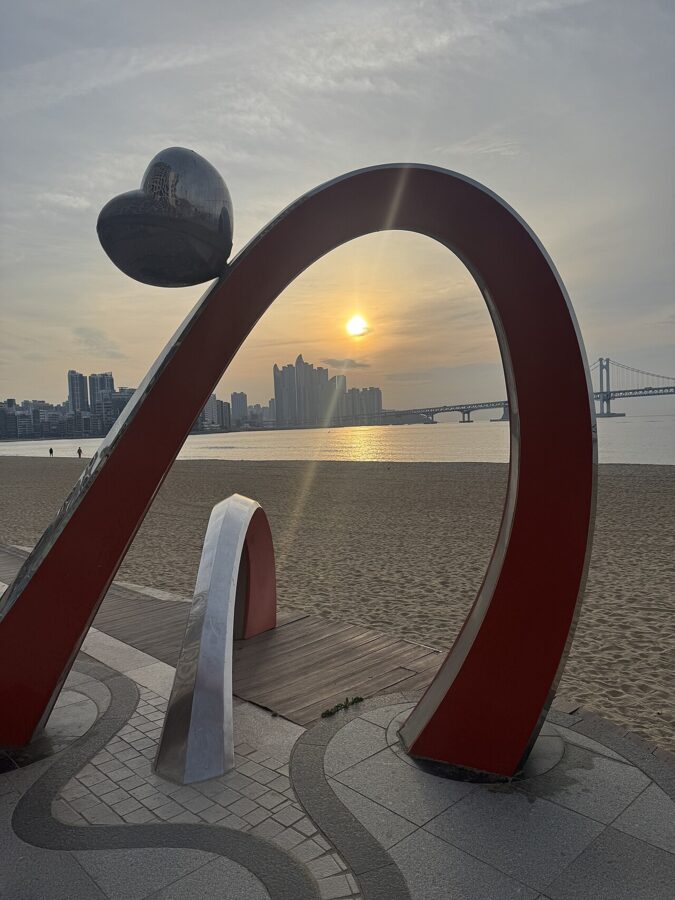
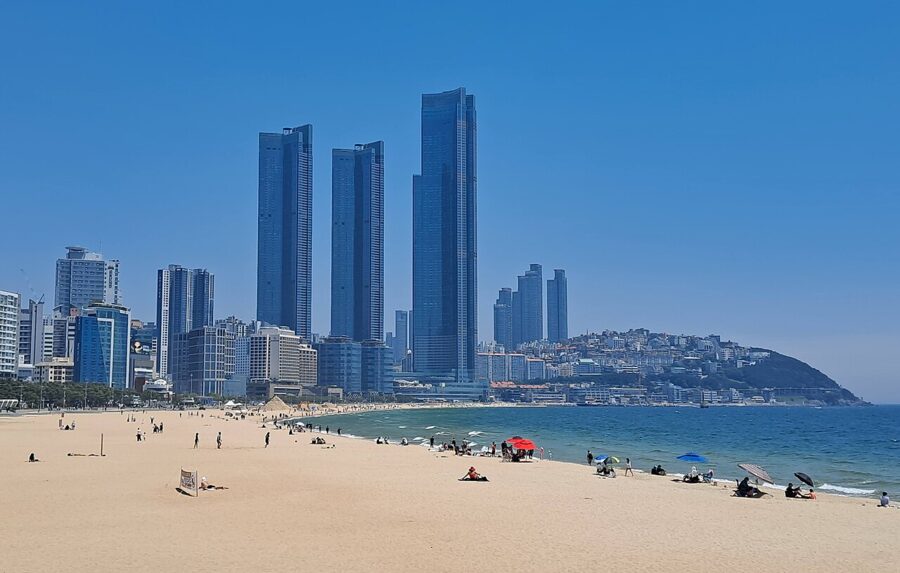
Haeundae Beach is 1.5 km of sand with hotel towers behind it, 15 minutes on foot from exit 5 of Haeundae Station. It is the easiest place to start a session and the hardest to make look like anywhere in particular. I would use it at sunrise, not as the centerpiece.
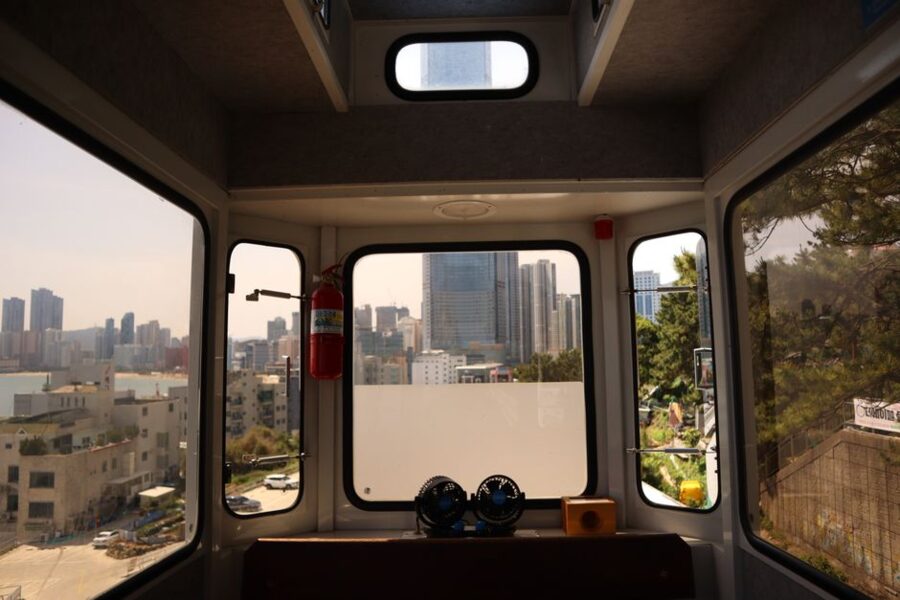
The centerpiece is east of the beach, on the old coastal railway that is now Haeundae Blueline Park. Four-seat Sky Capsules run 7 to 10 meters up between Mipo and Cheongsapo, 2 km in about 30 minutes one way. Below them the Beach Train links Mipo and Songjeong, stopping at Dalmaji Tunnel, Cheongsapo, Daritdol Skywalk and Gudeokpo.
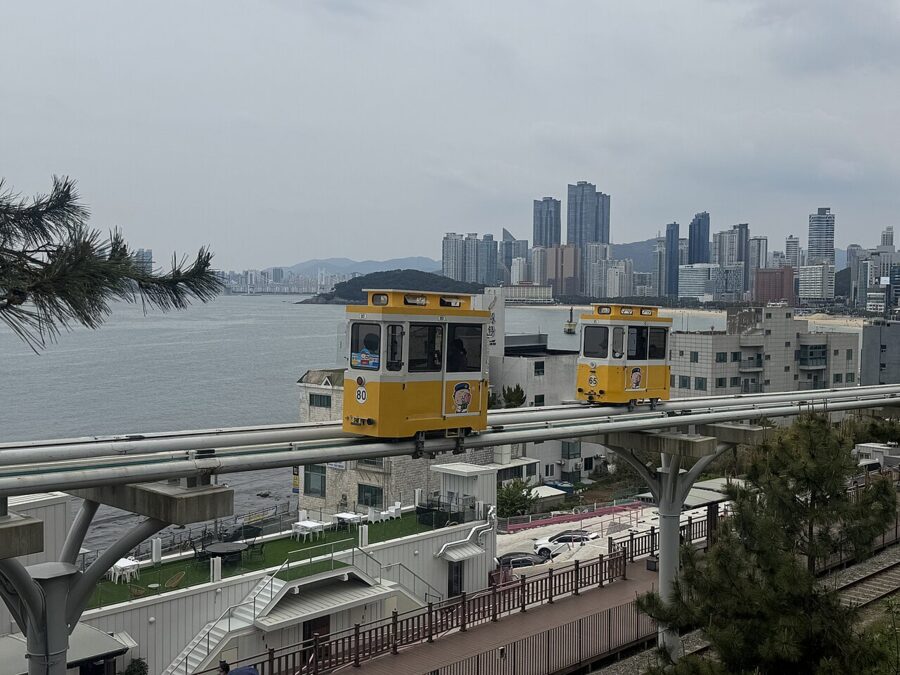
The Blueline Park fares were revised on May 1, 2026. A capsule now costs ₩50,000 (about US$37) for two, ₩55,000 (US$41) for three and ₩60,000 (US$45) for four. A single Beach Train ride is ₩8,000–10,000 (US$6–7) and an all-stops day pass ₩16,000 (US$12).
Capsules start at 8:30 a.m. all year. They stop at 6 p.m. in winter (November through February), 6:30 p.m. in March, April and October, 7:30 p.m. in May, June and September, and 8:30 p.m. in July and August.
Book online before the day, and take the first or last hour. Sitting face to face in a glass box above the sea is one of the few places where a couple portrait looks unposed without trying. Ride from Cheongsapo toward Mipo and you finish facing Haeundae’s towers.
Cheongsapo
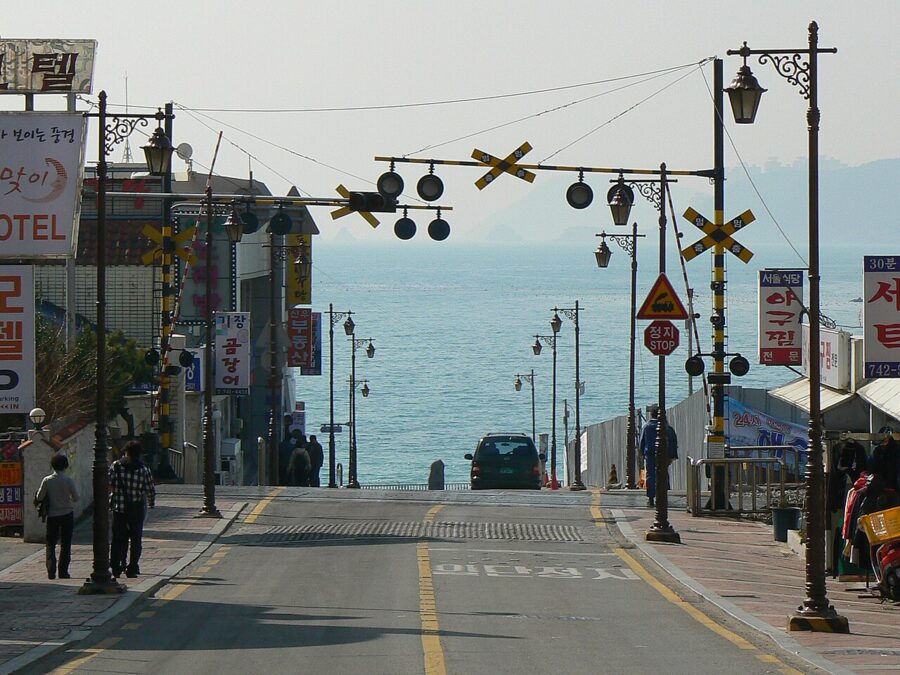
Cheongsa means “blue sand”, and Cheongsapo is a working fishing harbor with a red lighthouse and a white one on its breakwaters, and the Daritdol Skywalk running out over the water beside them. It is the place on the east coast for a portrait with boats and nets in it rather than hotels.
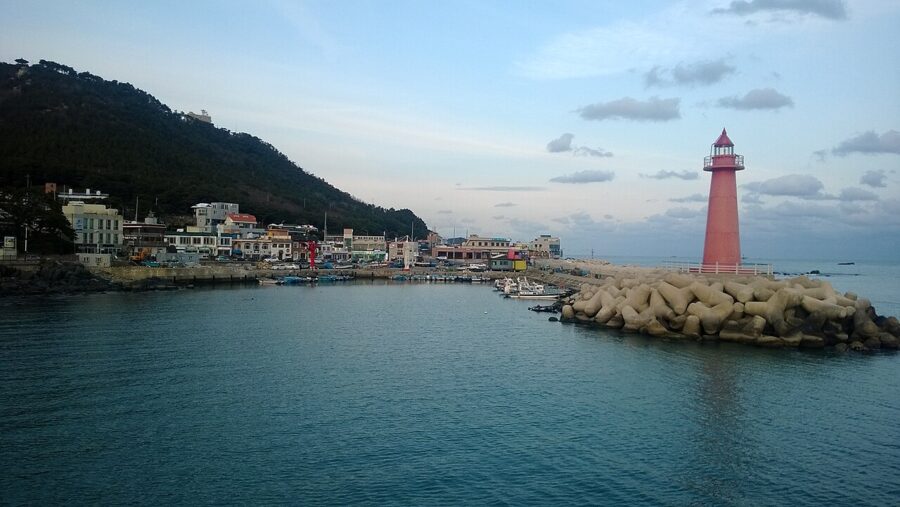
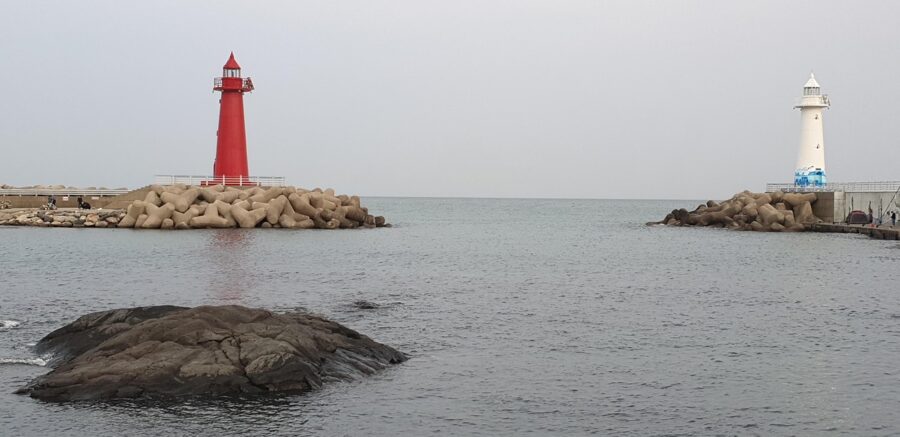
Take village bus Haeundae-gu 2 from exit 5 of Jangsan Station, or ride one stop from Mipo. People mend nets here for a living, so a photographer on the quay should not be in anyone’s way.
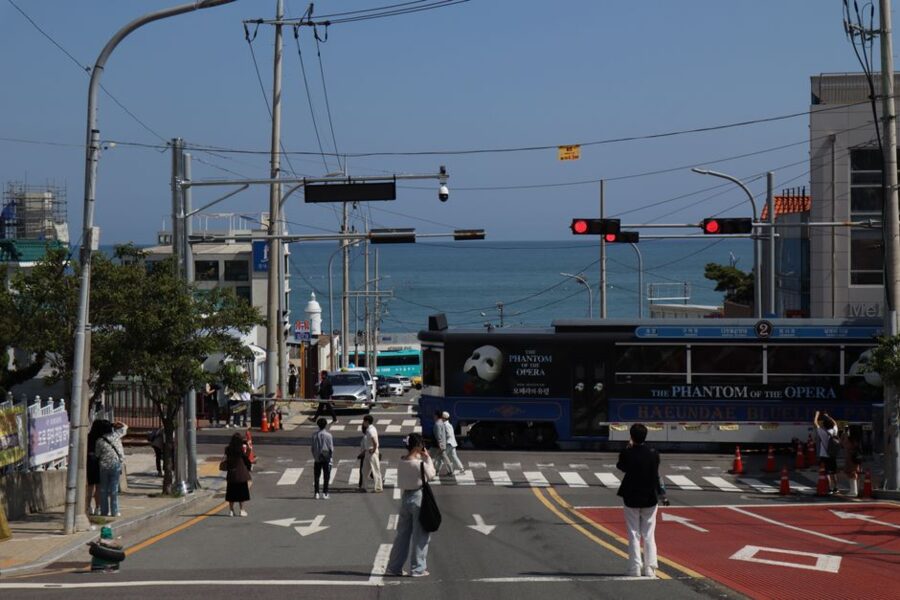
Haedong Yonggungsa, the temple by the sea
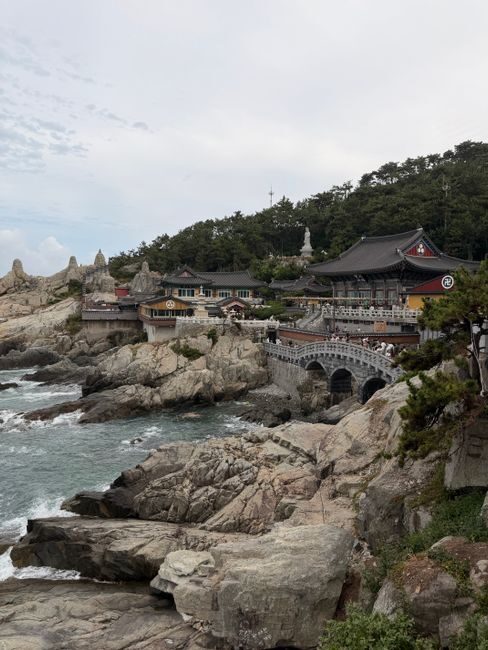
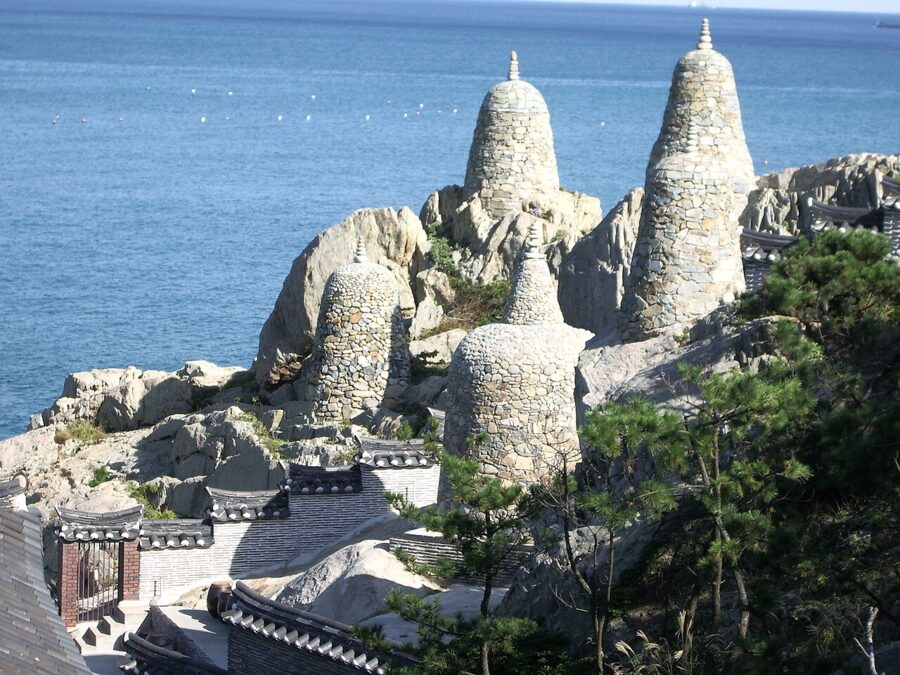
Most Korean temples sit in mountain valleys. Haedong Yonggungsa, on the Gijang shore north of Haeundae, sits on the rocks themselves. Its name, “Dragon Palace Temple of the East Sea”, is said to come from a dream of the monk Jeongam in which Gwaneum, the bodhisattva of compassion, rose from the sea on a dragon. It is a working Buddhist temple, and the people praying at the seaside Gwaneum statue above the main hall are not anyone’s backdrop.
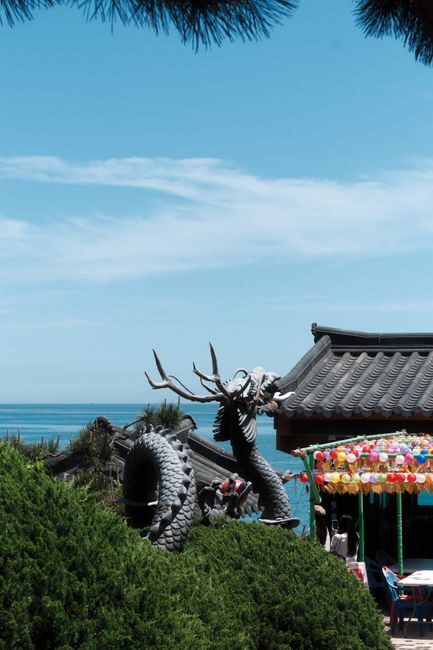
Visit Busan’s page for the temple gives its hours as 4:30 a.m. to 7:20 p.m. daily, last entry 6:50 p.m. Admission is free; the car park charges. The etiquette it asks for is short: lower your voice, use the side doors of the halls because the central door is for monks, and line up your shoes. My own rule is to keep the camera off anyone bowing.
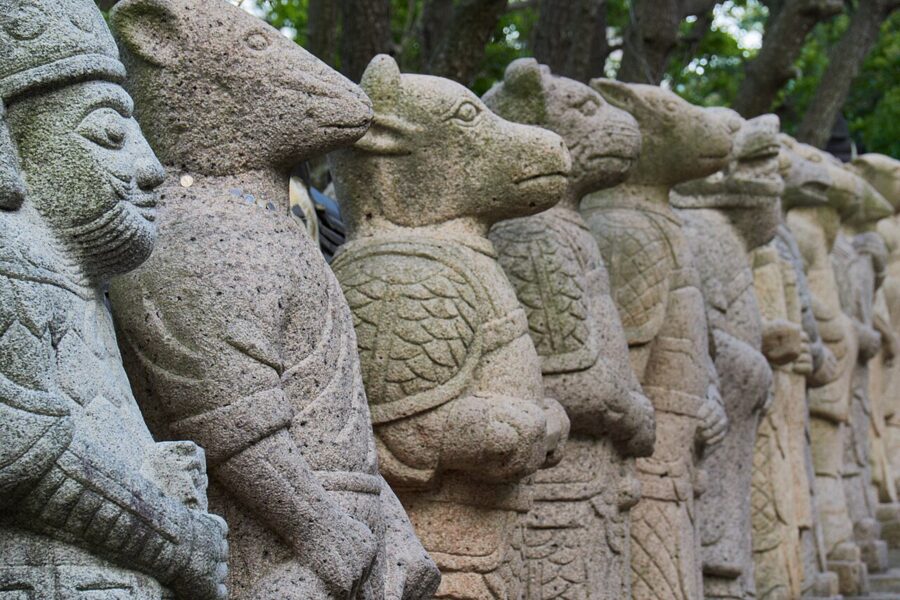
Come for sunrise, or not at all. The temple faces east over open water, so first light lands on the roofs and the Yongmungyo bridge while the steps are at their quietest. Buses 181, 100 and Haeundae 9 run from exit 7 of Haeundae Station, and bus 139 from exit 1 of Osiria Station; for a dawn shoot, take a taxi.
Gamcheon Culture Village and its new rules
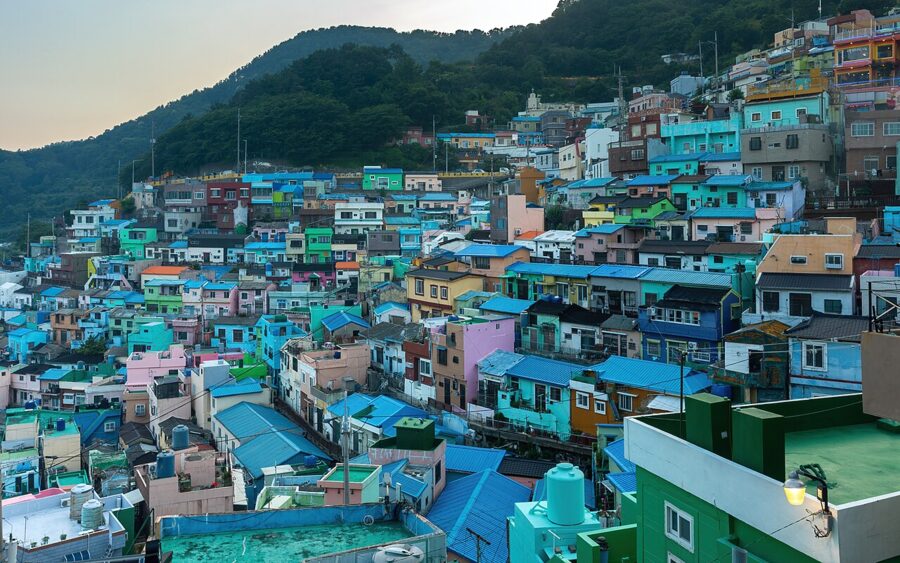
Gamcheon is a hillside of small terraced houses in Saha-gu, settled by refugees during the Korean War. Its present shape dates from the 1950s, when a community of the Taegeukdo faith built it in rows, each house placed so as not to block the sun and view of the one behind. Painting began in 2009, and it has been one of Busan’s most visited places since.
Under the Gamcheon Special Management Area, designated by Saha-gu on August 1, 2026 and in force from January 1, 2027, the densely residential lanes are open to visitors only from 9 a.m. to 6 p.m. In the same hours, tourist vehicles, taxis included, may not drive the roughly 1 km of Gamnae 2-ro from the information center to the “Memories’ Shadow” photo zone. Fines for that begin on January 1, 2028.
Groups of ten or more must buy the official village map, which covers a big family shoot too. Photo zones such as the Little Prince and fox statue are managed for queues, and noise, litter and intrusions on residents’ privacy are policed. Do not photograph into homes or stand in doorways, and do not fly a drone.
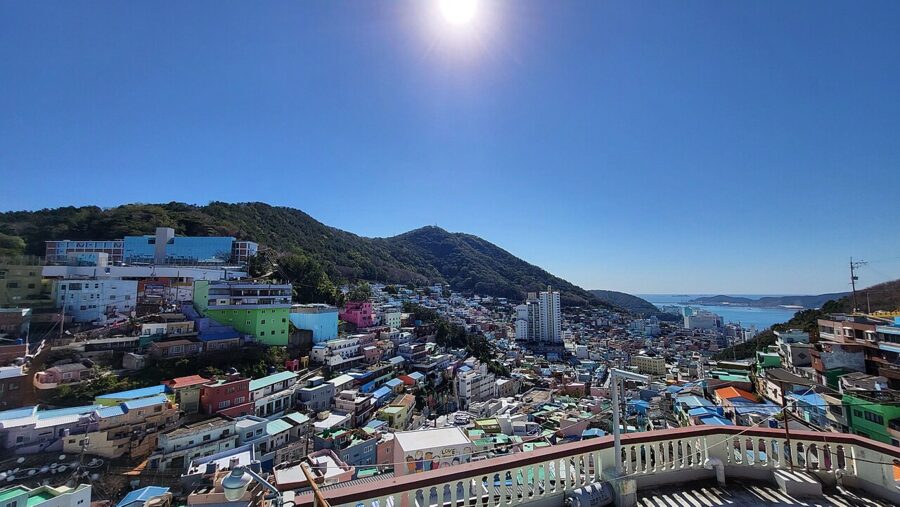
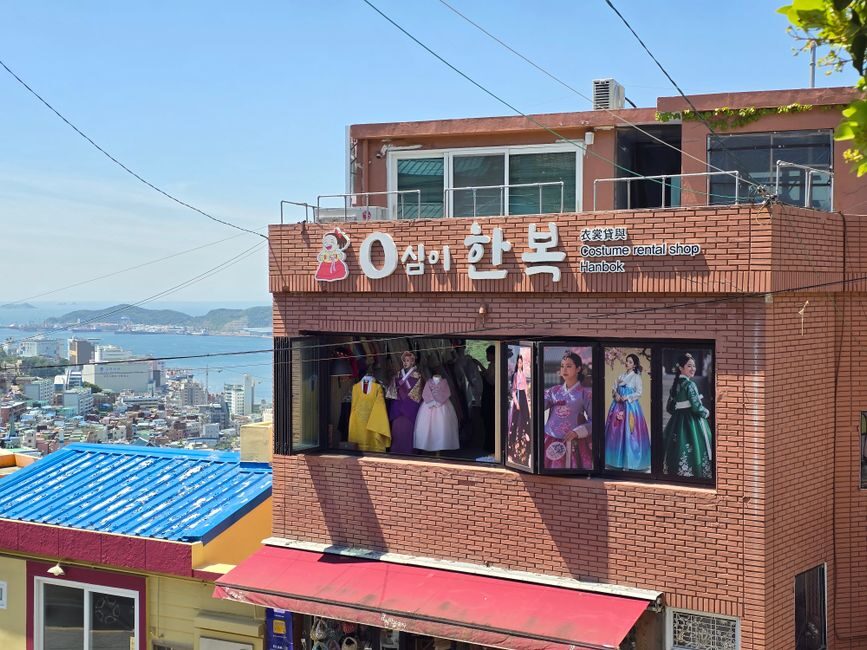
A session here works best on a weekday soon after 9 a.m., using the upper roads and viewpoints rather than the alleys. Village buses Seo-gu 2, Seo-gu 2-2 and Saha 1-1 climb from exit 6 of Toseong Station; the public car park under the Busan Education History Hall has 78 spaces. Hanbok shops in the village make it the natural place for a hanbok portrait.
Huinnyeoul Culture Village
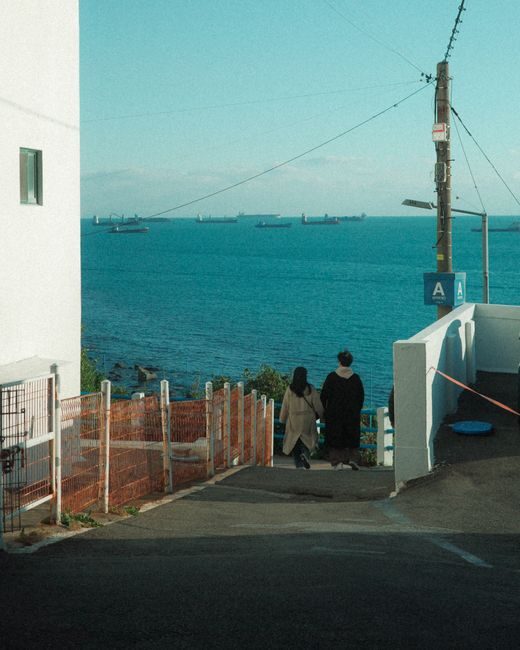
On the island of Yeongdo, Huinnyeoul is a row of houses along the top of a sea cliff above the Jeoryeong Coastal Trail. The name refers to water at the foot of the hill that tumbled white like falling snow. Renovated into a culture village in December 2011, it is now 14 alleys of cafes and workshops, with ships riding at anchor in the outer port below.
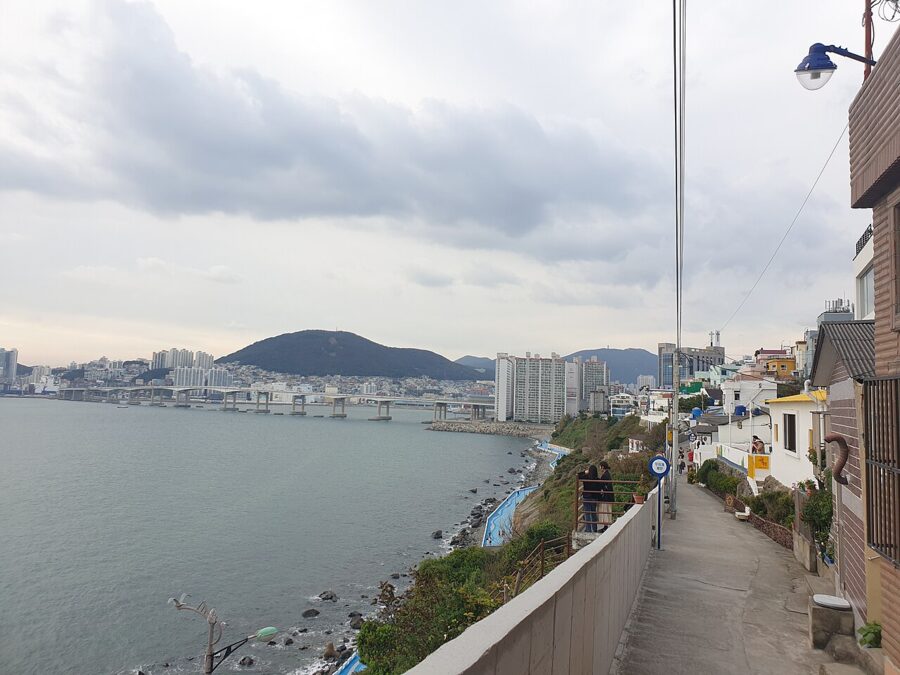
It is the most romantic place in the city to be photographed and, on a weekend, one of the most crowded. Go on a weekday for the last two hours of light, and follow the village’s request to respect the people who live here. Buses 7, 71 and 508 run from exit 6 of Nampo Station to Baengnyeonsa Temple stop.
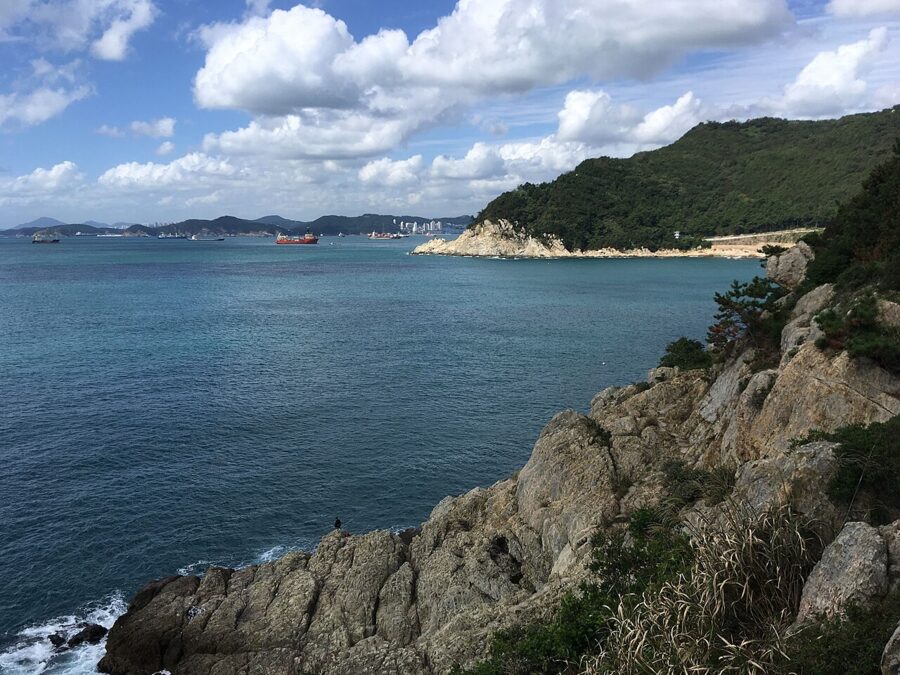
Taejongdae
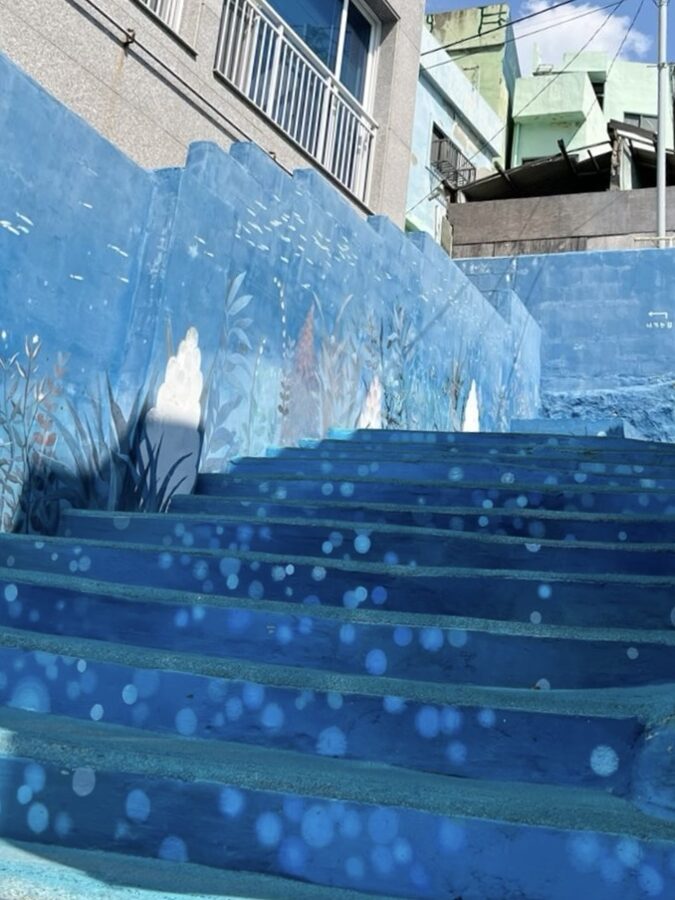
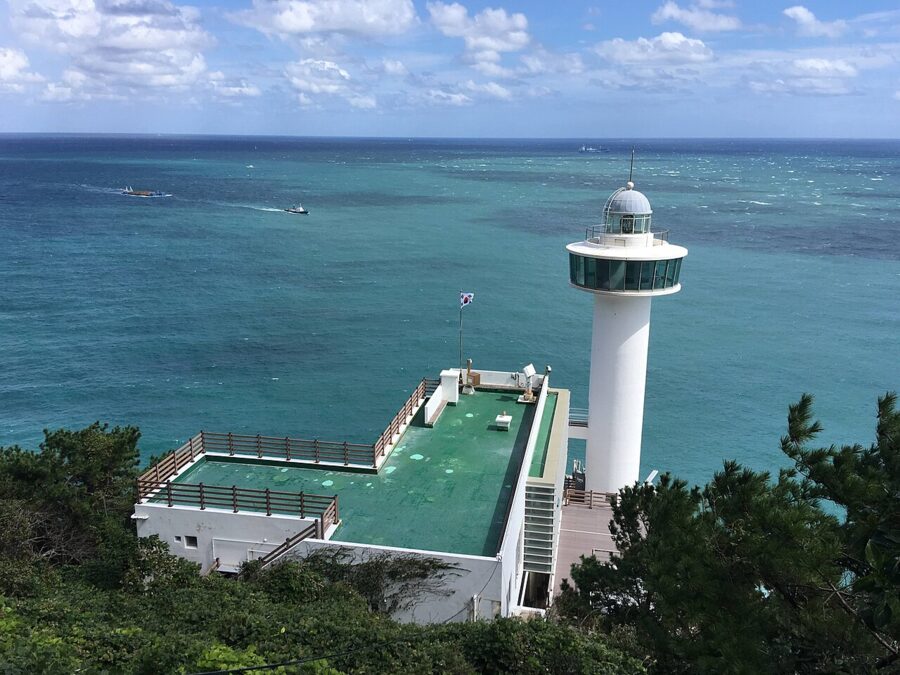
At the southern tip of Yeongdo, Taejongdae is a wooded headland with layered cliffs dropping into the sea. Tradition says King Taejong Muyeol of Silla practiced archery here. The Yeongdo Lighthouse below the observatory has been lit since 1906, and a rock beneath it carries the legend of a wife who waited for her husband’s boat until she turned to stone.
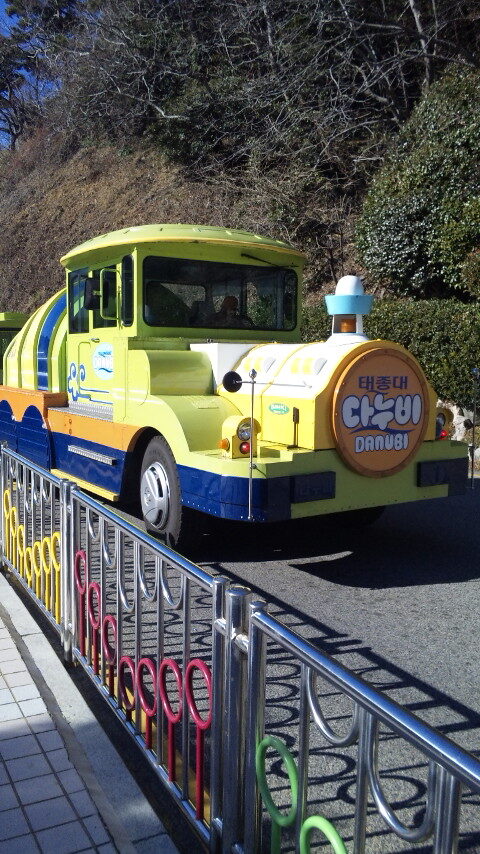
The park is free, and most people ride the Danubi road train around the headland. Visit Busan lists the Danubi as closed on Mondays. It runs 9:20 a.m. to 8 p.m. in June, July and August, and 9:20 a.m. to 6 p.m. from October through April.
Igidae and the Oryukdo Skywalk
Between Yeongdo and Gwangalli, the Igidae coast in Nam-gu is a cliff path through pine woods with Gwangan Bridge and the Haeundae skyline across the bay. Off its southern point lie the Oryukdo islets, five at low tide and six at high, which is where the name comes from, and part of the Busan National Geopark.
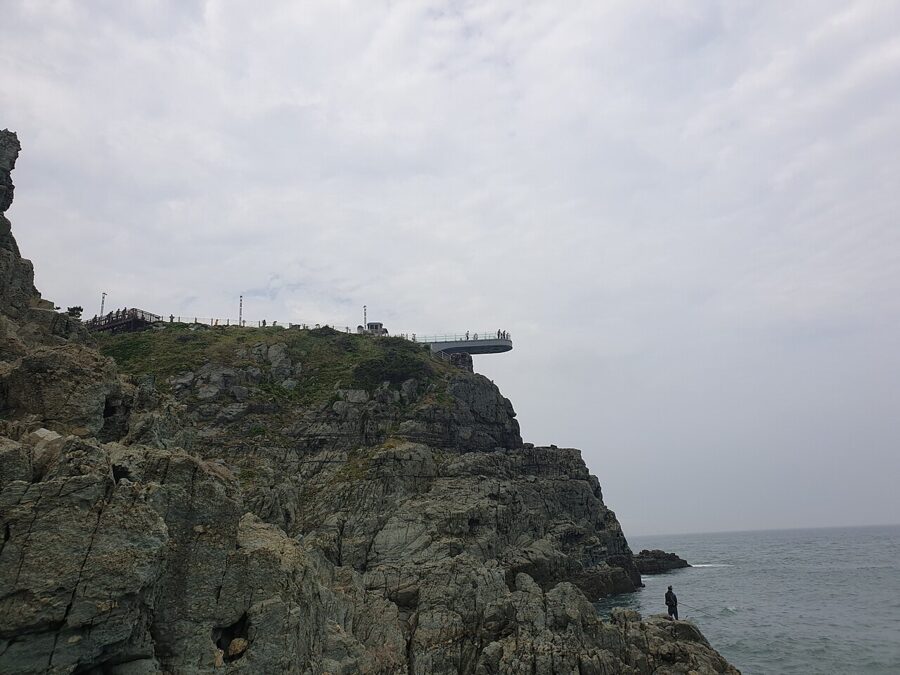
The Oryukdo Skywalk is free, open 9 a.m. to 6 p.m. with last entry at 5:50 p.m., and until 7 p.m. in June through September. It closes for snow, rain or strong wind. Buses 24, 27, 131 and Nam-gu 2 run from Kyungsung Univ.–Pukyong Nat’l Univ. Station.
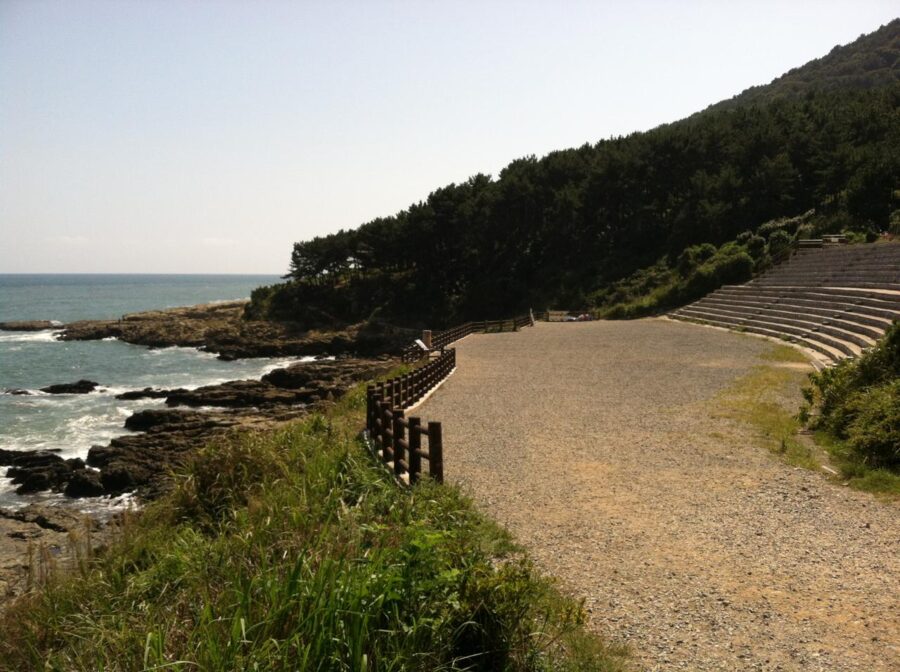
Igidae is where I would take anyone camera-shy. There are no queues and no shops, and walking gives a nervous subject something to do.
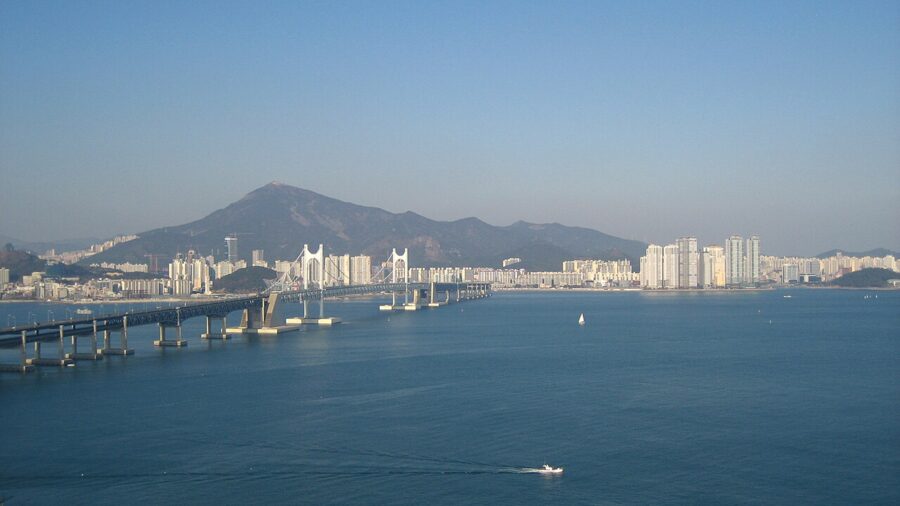
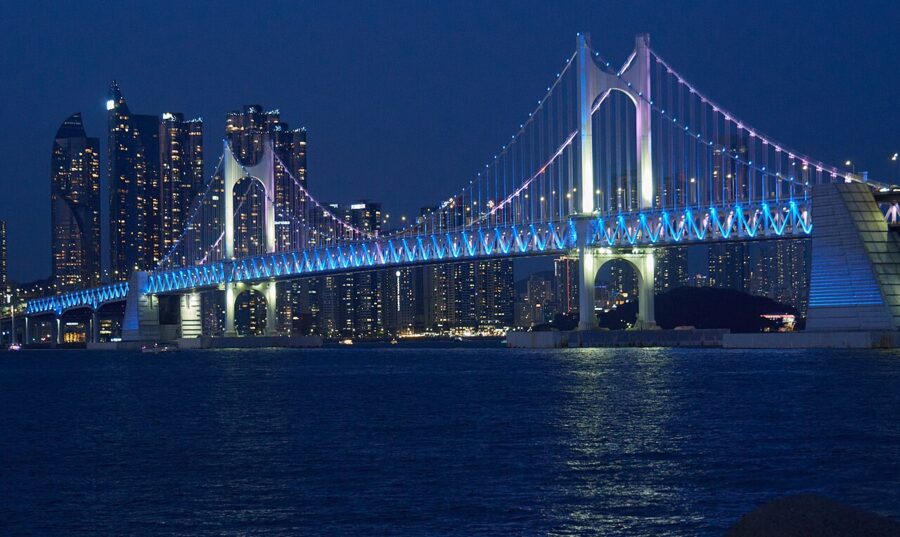
Gwangalli and the bridge at night
Gwangalli is the beach Busan uses after dark, with the lit Gwangan Bridge across the bay and a seafront of cafes, bars and buskers. A night portrait here is the most requested shoot in the city and harder than it looks. The bridge is bright, faces are dark, and the photographer needs a way of lighting you that does not look like a flash snapshot.
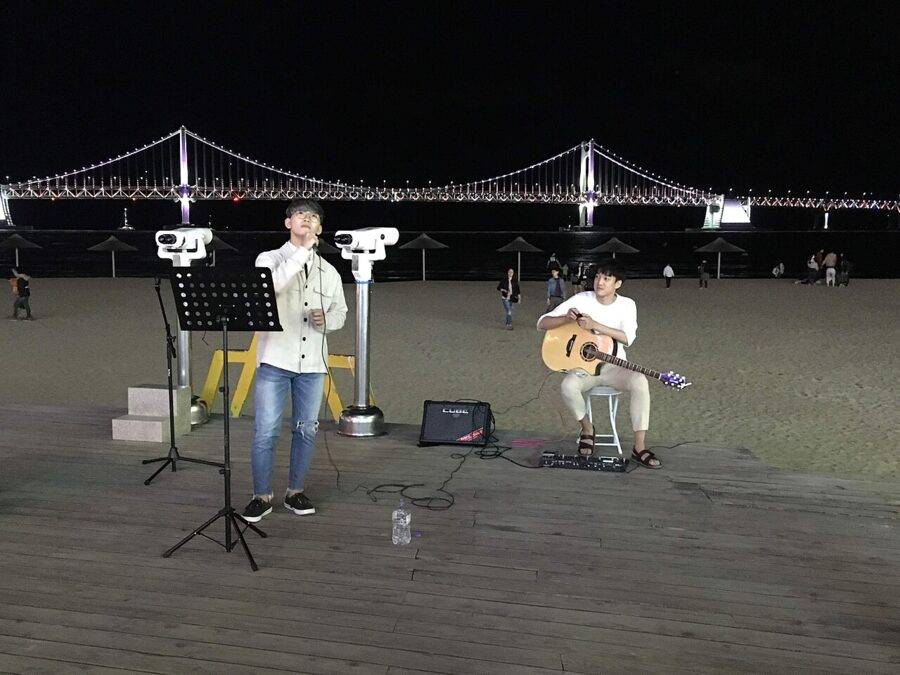
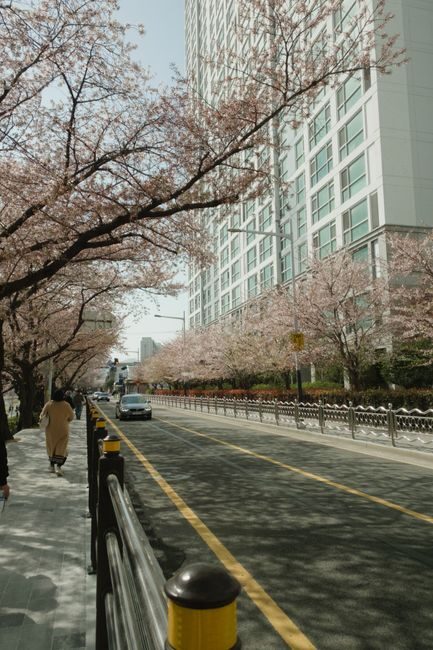
The beach is 13 minutes on foot from exit 5 of Gwangan Station and open at all hours. Start at blue hour, about 20 minutes after sunset, while the sky still has color. In spring, the Namcheon-dong cherry blossom street a few blocks back is worth the detour.
Light, weather and the seasons
The most useful fact for planning is when the sun rises and sets. These are approximate times for mid-month.
| Month | Sunrise | Sunset |
|---|---|---|
| January | 7:30 a.m. | 5:35 p.m. |
| April | 5:50 a.m. | 6:55 p.m. |
| June | 5:10 a.m. | 7:40 p.m. |
| September | 6:05 a.m. | 6:30 p.m. |
| November | 7:00 a.m. | 5:20 p.m. |
Cherry blossoms usually come around the start of April, along with the busiest weeks for photographers, so book early. Early summer brings sea fog that can swallow Haeundae’s towers in minutes and lift as fast. It is beautiful if you like mood and maddening if you came for blue sea.
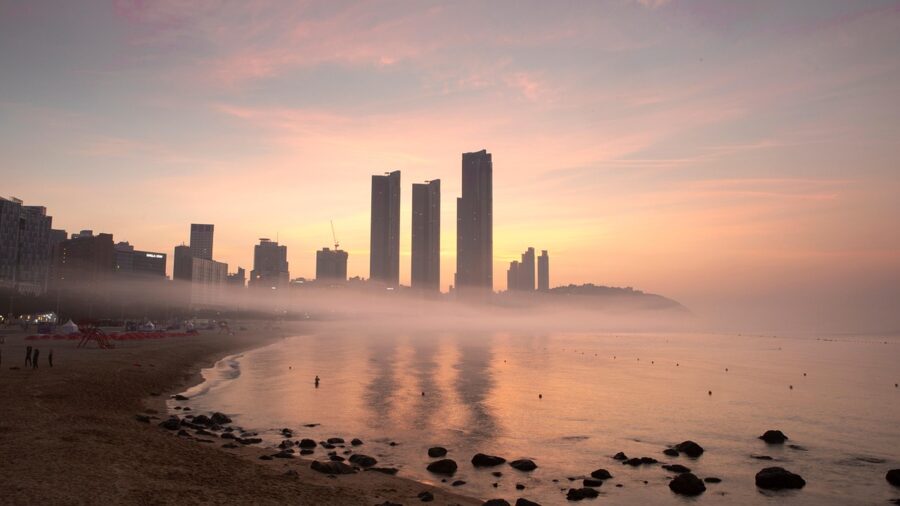
The monsoon rains usually arrive in late June and last through July, and late summer into early autumn is typhoon season. Autumn, from late September into November, is the most reliable season for clear air and soft afternoon light. Winter is cold and windy on the coast but often clear, and the low sun suits portraits better than most people expect.
What to wear
Dress for the place, then for the wind. The coast is windy most of the year, so long hair wants a tie and a light dress wants a photographer who likes movement. Plain mid-tones suit Gamcheon’s pastel walls; a single strong color carries on the gray rocks of Igidae and Taejongdae.
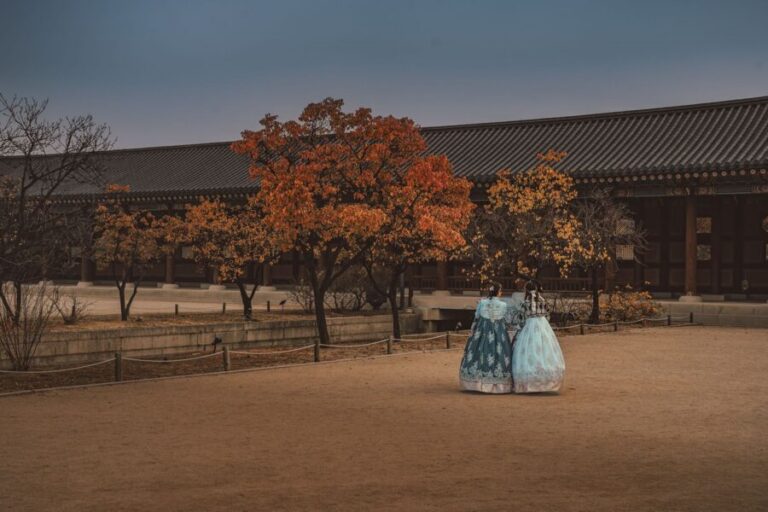
At Haedong Yonggungsa, cover shoulders and knees, and wear shoes that slip off if you plan to step into a hall. Every spot here involves stairs, so bring flat shoes and change for the frame. Keep a rented hanbok to one location: it is warm, and wearing it across the city on the subway makes for a long afternoon.
Planning the route on the day
The commonest mistake is a two-hour booking spread across the whole city. Busan is long, and the ride from Gijang’s temples to Yeongdo’s villages crosses all of it. Pick one cluster, two places for a short session, and let the light set the order.
- East, for a morning: Haedong Yonggungsa at sunrise, a taxi to Cheongsapo, the capsule to Mipo, then Haeundae Beach.
- West, for an afternoon: Gamcheon after 9 a.m., then Huinnyeoul in the last light. Add Taejongdae on a longer booking, but not on a Monday.
- Middle, ending at night: the Oryukdo Skywalk and Igidae in the afternoon, then Gwangalli for blue hour.
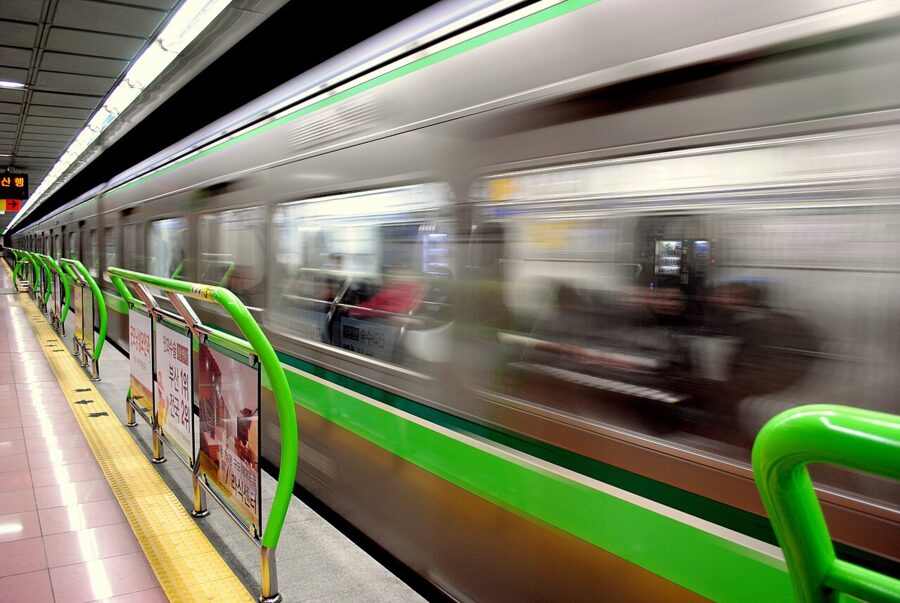
At Gamcheon, have your taxi stop at the information center or the public car park; during the day Gamnae 2-ro is closed to tourist vehicles. Metro Line 2 links Haeundae, Gwangan and the Oryukdo bus stop, and Line 1 serves Toseong for Gamcheon and Nampo for Yeongdo, so a session can follow the subway instead of the traffic.
Judging a portfolio, the Busan version
The general rules for judging a photographer, and booking advice that holds anywhere in Korea, are the same as for hiring a photographer in Seoul. In short: ask for a full gallery from one session, not a highlight reel; check that skin looks like skin in every picture; and make sure the person you message is the one who turns up with the camera.
Busan adds its own tests. Look for night pictures at Gwangalli where faces are clean and the bridge is still sharp, the hardest shot in the city. Look for a session shot in wind or fog, because you may well get one. Ask for Gamcheon or Huinnyeoul pictures from the past year, from someone who knows the new hours and the quiet corners, and be wary of a portfolio that is all Haeundae at noon.
Back at Haedong Yonggungsa, the gate opens at 4:30 again tomorrow. Book the photographer who suggests meeting you there, and bring a warm layer for the rocks.